Source: Aliran

Flawed thinking by government decision-makers will lead to white elephant projects, a ruined environment and a massive debt burden to future generations, says Khoo Salma Nasution.
I am alarmed at the lack of transparency and due diligence shown by the Penang state government over the “Penang Transport Master Plan” (PTMP).
Blueprints for public projects which run into billions of ringgit should be put up online instead of being cloaked in secrecy. Otherwise, the Penang people have no way of knowing if the state is getting a good deal, or if it is being seduced by developers into commissioning excess-capacity white elephant projects.
The PTMP was intended to solve Penang’s regular traffic congestion. Public transport ridership in Penang is currently less than 10% even after including school and factory buses.
The Halcrow plan was supported by civil society and endorsed by the Penang state government in 2013. It is a holistic plan for “moving people not cars” and for shifting Penang towards a 40:60 public transport:private vehicle mode split. The target of the Halcrow plan is for 40% of Penang’s population to take public transport to reduce carbon emissions, traffic congestion and dependency on private vehicles.
Aim high: initial unrealistic target of 42 million ridership
With the Halcrow plan in hand, the Penang government called for a request for proposals. The winning submission came from SRS Consortium, who had hired private transport consultants to produce reports according to the developers’ brief.
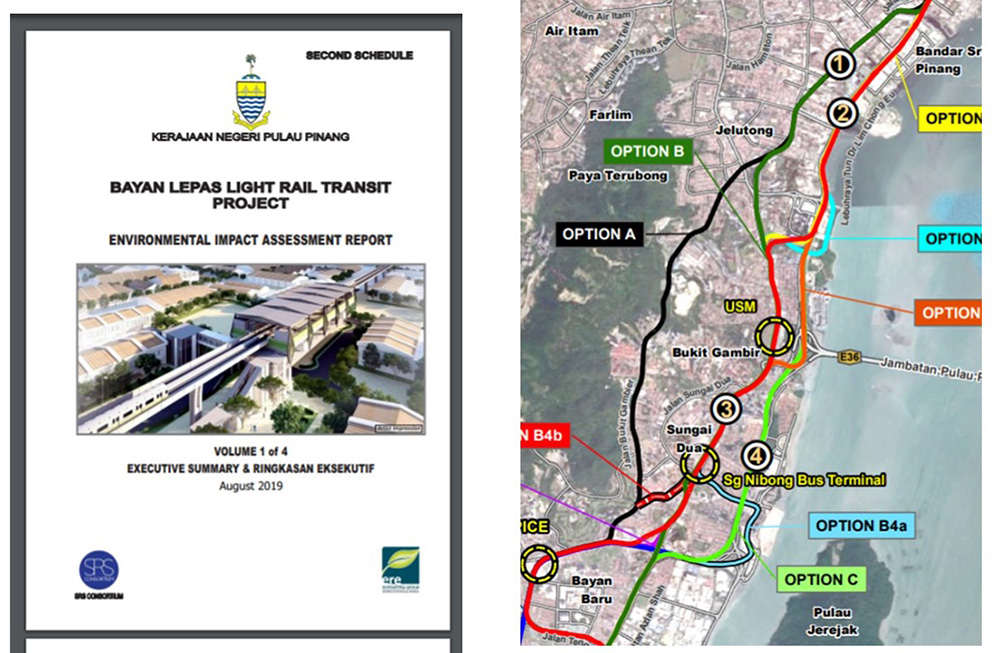
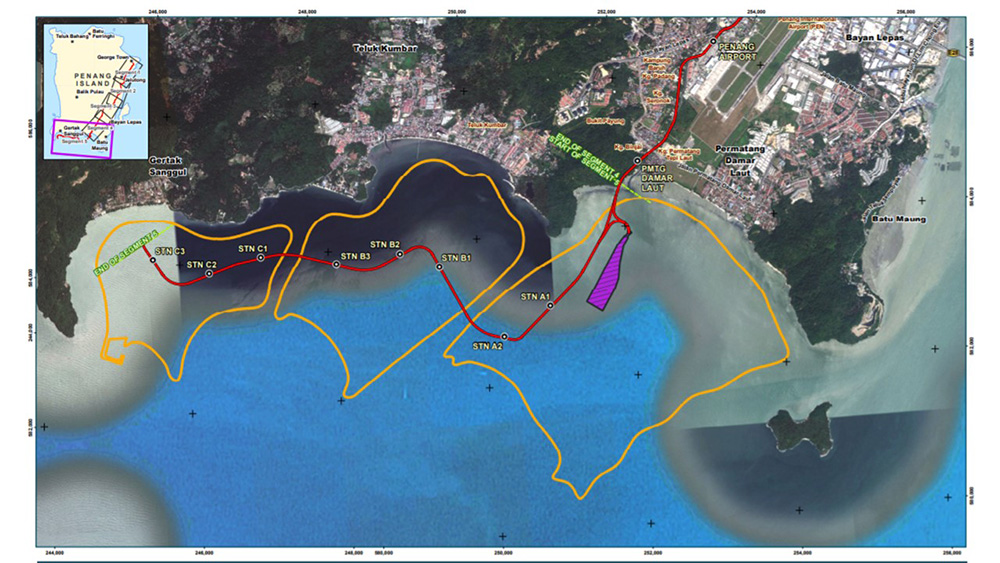
However, this new PTMP bears little resemblance to the Halcrow plan. SRS Consortium’s flagship public transport project is the 29.9km Komtar-Bayan Lepas elevated light rail, which is supposed to eventually end at the three proposed reclaimed islands of the environmentally destructive Penang South Reclamation project.
SRS Consortium initially mooted the Bayan Lepas elevated light rail line at a cost of RM8.4bn, entailing an annual operations and maintenance budget of a whopping RM170m per year. A high ridership of 42 million passengers (115,000 per day) was forecasted for the first year. Operations were predicted to break even only in the eighth year of operation.
Penang Forum and other transport experts wrote dozens of letters to the press questioning the feasibility of the elevated light rail: “Is the LRT too expensive to build and operate?” “Is 42 million ridership a realistic figure?” “Will Penang be saddled with a RM100m annual deficit if the projections prove overly inflated?”
Yet, Chow Kon Yeow – first as State Executive Councillor for Transport and then as Chief Minister – repeatedly defended the 42 million projected ridership figure.
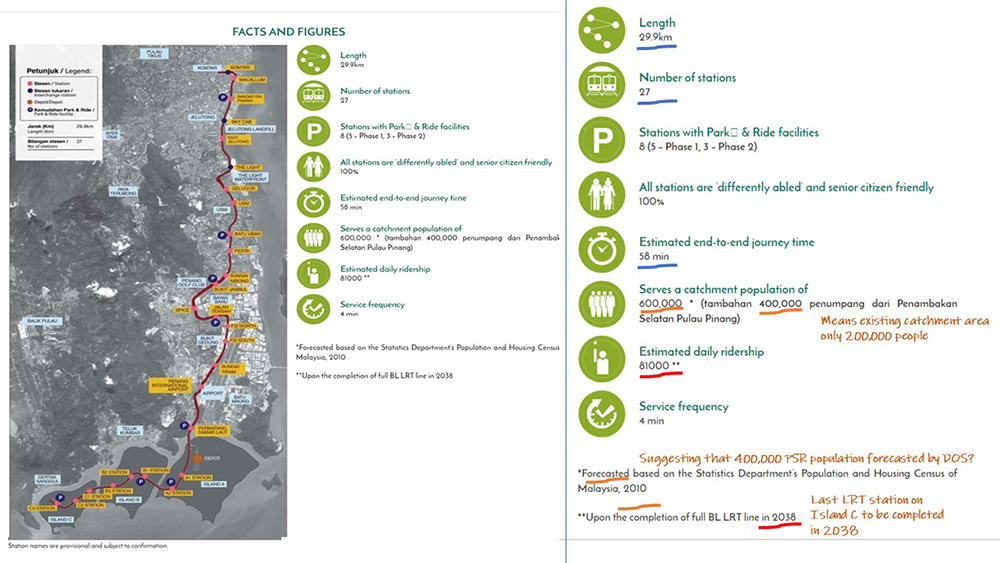
The light rail will move people between Komtar and a terminal about 100m–150m from the present Bayan Lepas airport terminal. During the period of the Bayan Lepas light rail public inspection from August to November 2019, the official website gave a ridership forecast of 81,000 ridership per day, which works out to 29.6 million annually. The website also mentioned a catchment population of 200,000 people for the Komtar–Bayan Lepas corridor.
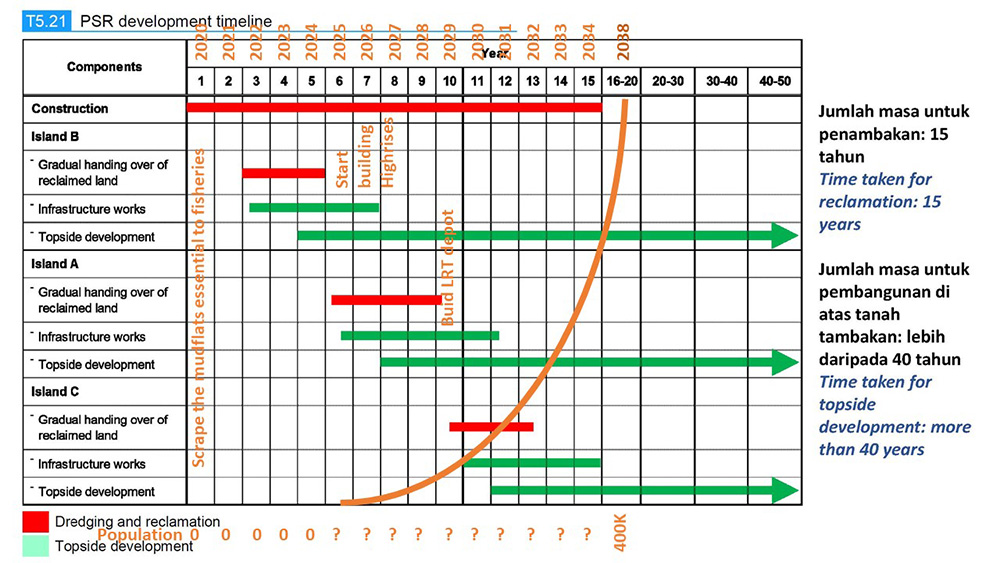
Judging from the proposed Penang South Reclamation timeline shown in the environmental impact assessment of the reclamation, the light rail depot on Island A can only be completed in 2029, at the earliest.
The viability of the elevated light rail is contingent upon the population of the three islands booming fantastically to 400,000 by 2038; for only with a total population catchment of 600,000 would the light rail be able to achieve the projected 29.6 million ridership.
Swing low: current modest target of seven million ridership
Penang Forum has several times noted abrupt changes to the PTMP proposal without any rhyme or reason. We have long wondered if the Penang state government has the competency to scrutinise the figures which appear to be “plucked from the sky”.
After the Bayan Lepas light rail public inspection period (FMT, 8 November 2019), the chief minister suddenly announced a new drastically (and more realistic) reduced initial ridership forecast of seven million in 2027, alongside the new operations and maintenance cost of RM32m. Ridership is expected to increase to 16 million by 2032.
The earlier date of 2027 for launching the elevated light rail is predicated on a plan to start with the reclamation of Island A (where the light rail depot is located), instead of starting with Island B as specified in the environmental impact assessment for the southern reclamation. The revelation that Island A would be reclaimed before Island B appeared in the real estate advertisement “Future Islands – A Boon for Malaysia’s Economy” (Bloomberg, 6 December 2019), clearly contradicting the environmental impact assessment timeline.
Taking into account the reduced projected ridership, is an elevated light rail system for Penang still justifiable? This year alone (2019), the goalpost for the initial year of operations has shifted from moving 42 million to 29.6 million to seven million people!
Improving public transport state-wide or only in one transport corridor?
Lim Mah Hui of Penang Forum sought clarification for the new elevated light rail figures at the Penang Transport Council meeting, chaired by the chief minister himself.
The Penang Transport Council was convened on 12 December 2019, for the first time in one and a half years! At this meeting, there was no report, fact sheet or any sort of information on the table. We were told to refer to the slides shown.
The engineer representing SRS Consortium verbally explained to Lim that the original target ridership (42 million) for the first year reflected a 40% mode share target, but as the original target has since been relaxed, a much lower ridership (seven million) is forecasted for the first year, and the projected operations and maintenance costs have been reduced as a consequence.
Then I asked the chief minister: is SRS Consortium’s initial 40% ridership target applicable to the whole of Penang state or to just to the Bayan Lepas elevated light rail corridor?
Instead of replying, the chief minister referred my question to the engineer.
The engineer responded by saying he believed (wrongly) that even the Halcrow plan is similarly not applicable to the whole state.
I was not the only one in the room surprised by this answer!
The Halcrow plan proposes the establishment of seven tram lines on Penang Island and three bus rapid transit lines in Seberang Perai, covering the densest traffic corridors in the state.
Halcrow’s comprehensive transport plan aimed for 40% of state-wide public transport ridership, while it appears that SRS Consortium’s PTMP might be considering the Bayan Lepas corridor only, at least for the first decade or two.
The budget is estimated at around RM10bn for each package. Which one provides value for the rakyat’s money?
PM criticised Klang MRT for excess capacity: “Too early to build”
In September 2018 the Transport Minister Anthony Loke advised that elevated light rail might not be the best option for Penang. The Land Public Transport Commission (former Spad, now Apad) even dared to suggest that a tram system would suit Penang better than an elevated light rail system.
But the Penang chief minister had already been sold on the elevated light rail as a magic bullet for Penang’s traffic congestion problem. Professional advice was ignored.
Following a high-level meeting in Putrajaya, Loke acquiesced to the Penang chief minister’s preferred legacy project. In July this year, the Ministry of Transport gave Penang’s elevated light rail proposal a conditional approval, with 30 conditions attached.
Prime Minister Dr Mahathir Mohamad frowned upon the Klang Valley mass rapid transit (MRT) as an excess-capacity project: “When you build something that will only have full ridership maybe 20 or 30 years from now, it is too early to build.”
Even the Gamuda managing director admitted that the Klang Valley MRT was indeed “too big and too luxurious”, but he contended that that was what the government wanted, and they were only doing their part as project delivery partner (The Edge Markets, 7 December 2018).
The objective of business is to make profit, but surely, the government has a responsibility to practise financial prudence and watch out for the public interest. Why spend RM8bn–RM10bn on an elevated light rail system to move 16 million people by 2032 when an automated rapid rail transit (ART) or bus rapid transit or improved bus system can do this for a fraction of the cost?
It seems that the “white elephant” is the only elephant species in Malaysia well protected by political patronage.
Not mega-projects, but the modest bus is the most efficient for moving people
Penang has been investing far more in road expansion than in public transport. It should be making a radical shift to “disincentivising” private vehicle use in favour of public transport, as other cities have done, in light of the realities of climate change. Bus users in Penang are complaining daily about the poor service along certain routes.
A 21st Century bus system, with an extensive network of flexible, new-tech buses and info systems, with better routes, frequency and coverage, would be the most practical scheme for Penang. Such a system can be quickly implemented and scaled up, aiming to provide a well-serviced bus stop within 10 minutes’ walk of more than half of Penang’s population, within a few short years.
It appears that the Penang government has not grasped the fundamental principles of an efficient public transport system. In cities like Singapore, Hong Kong, London, the bus system is still the backbone of the modern transport system, with buses carrying more passengers than rail. Can most people really save time and money by commuting on elevated light rail if they cannot even get to the rail station by bus?
Without first building a successful bus system, the introduction of any mass transit system will be doomed to failure. Judging from SRS Consortium’s PTMP, there is a real danger that better, cheaper, faster (sooner) and more realistic solutions to Penang’s traffic woes will be willfully ignored due to the chief minister’s elevated light rail and highway mega-projects fetish.
Penang Forum’s simple request to have the PTMP reviewed in an open manner has been repeatedly turned down. We strongly suspect that the PTMP choices are not backed up by any cost-benefit analysis.
As demonstrated time and again, developers of infrastructure projects and vendors of rail systems like the elevated light rail and MRT are only too happy to sell to politicians who are shopping for status symbols with the rakyat’s purse, but do not really understand what type of system the city needs.
Flawed thinking by government decision-makers will lead to white elephant projects, a ruined environment and a massive debt burden to future generations.
Khoo Salma Nasution is a Penang Forum steering committee member
AGENDA RAKYAT - Lima perkara utama
- Tegakkan maruah serta kualiti kehidupan rakyat
- Galakkan pembangunan saksama, lestari serta tangani krisis alam sekitar
- Raikan kerencaman dan keterangkuman
- Selamatkan demokrasi dan angkatkan keluhuran undang-undang
- Lawan rasuah dan kronisme